 The capillaries of India's cities are clogged with every imaginable form of cacophonous conveyance: hulking buses, braying bullock carts and motorbikes stacked with families of five all jostle for space on the roads.
The result is that most of India's commuters idle angrily in traffic for hours every day. The government is trying to play catch-up with a long string of mass transit projects, but most residents pine for the status, peace and luxury of a car all their own.
After almost a year of delays, the Indian automobile manufacturer Tata is finally set to answer that call by releasing the world's cheapest car next month. Priced at about $2,000, the Tata Nano is a five-seat, air-conditioned, gasoline-powered car. It is also a nightmare for environmentalists, who predict sky-high sales will further pollute India's already smog-filled air.
 Irish company Greenaer are the official importers for the Reva, which is made in India.
  Indian news service Rediff.com recently reported that the Japanese government has approved a $2,600 subsidy for every one of Reva Electric Car Company's electric vehicles (EVs) sold in the country.
 Kapil Sibal, Union Minister for Science & Technology, launched ‘REVA-NXG,’ the next generation Electric Vehicle created by REVA Electric Car Company Pvt. Ltd.
 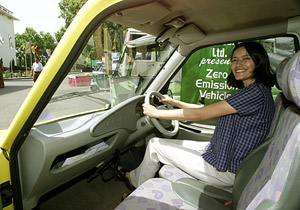 A model sits inside a Reva electric car in front of the Ministry of Non-Conventional Energy Sources building in New Delhi in this file photo. India's first electric car, launched two years ago, has received European Economic Community
  If a group of defence scientists and automobile engineers has its way, people could soon be driving in India
